
For raised homes and pier foundations
Crawl Space Encapsulation in Baton Rouge, LA
Stop pulling humid air under the house and give the floor a dry, insulated base.
- Free on-site estimates
- Written quote listing foam type, thickness and R-value per area
- Ducts, moisture and termite clearances checked before we insulate
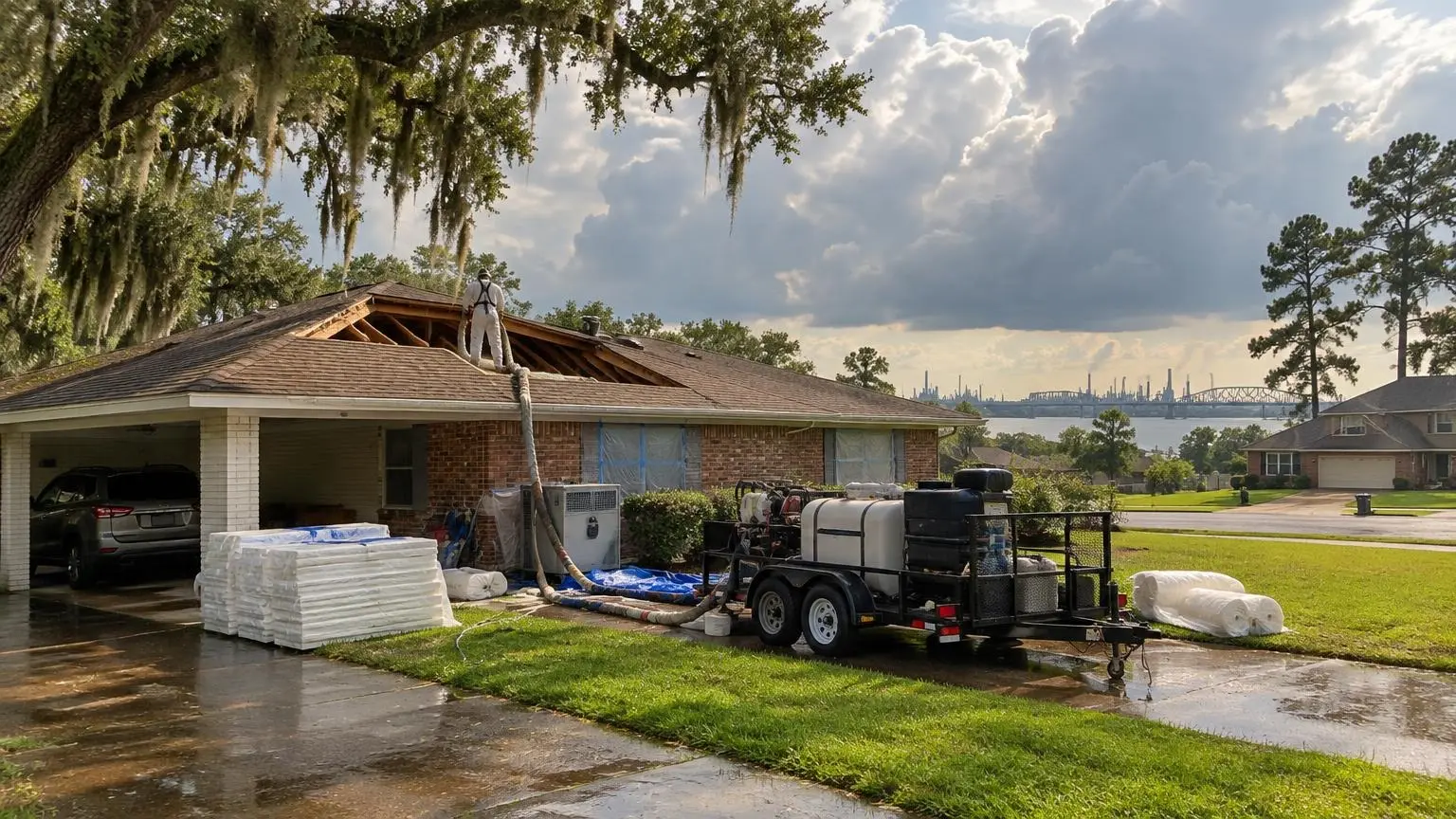
Dry Under the House
Crawl space encapsulation closes off the space under a raised home so it stops breathing humid outside air. In Baton Rouge, where Wikipedia lists average relative humidity near 74%, an open vented crawl space pulls in damp air all summer. That air hits cool ductwork and floor framing, condenses, and leaves you with sweating ducts, cupped floors, musty smells and wood that stays damp.
What encapsulation means
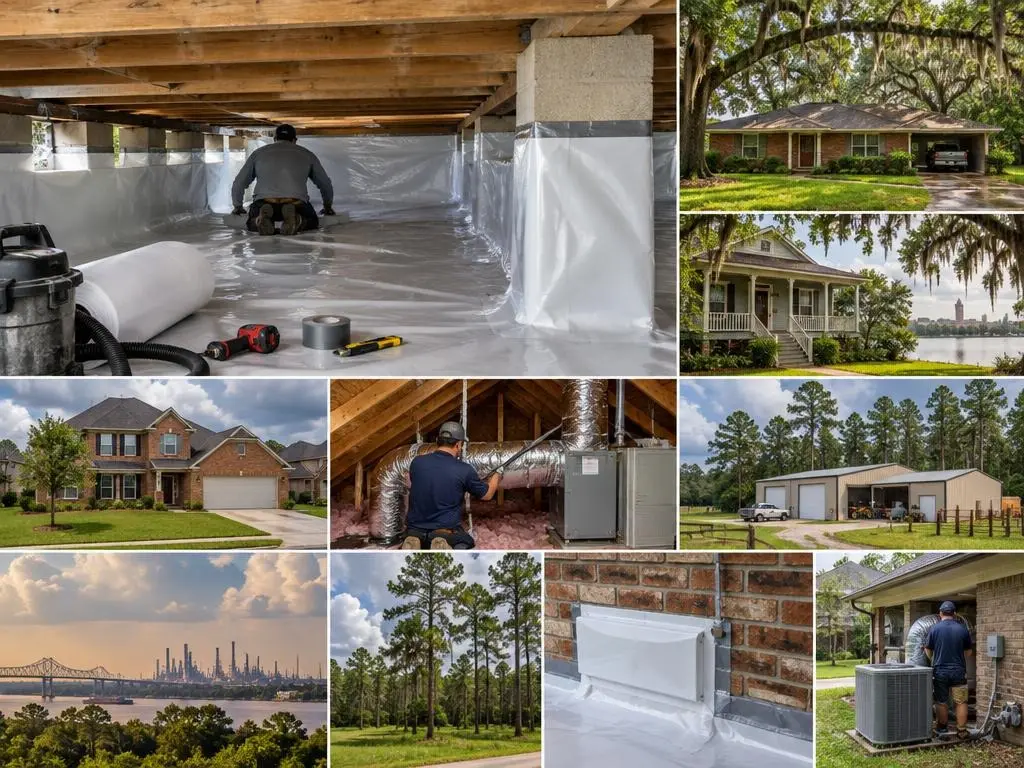
A full encapsulation lays a heavy liner across the ground and up the foundation walls, seals its seams and edges, closes the foundation vents, and controls the air in the space, usually with a dehumidifier or a small supply of conditioned air. With the space closed, the walls can be insulated with closed-cell foam or rigid board instead of insulating the floor above. Not every house needs all of that. Some need a ground liner and vent covers; some need the floor insulation fixed; some need drainage first. We tell you which after we crawl it.
Water first
If water stands in the crawl space after rain, a liner alone will not solve it. Grading, gutters, downspout extensions or a drain may need to come first. Much of the capital region is low and flat, and the August 2016 flood showed how fast water can rise; if your house has a flood history we look for damaged framing and soaked insulation that should come out before anything new goes in.
Termites and inspection gaps
LSU AgCenter calls the Formosan termite Louisiana's most destructive insect, found in about half of the parishes, and local code criteria rate termite risk as very heavy. Foam on foundation walls can hide termite tubes, so we leave an inspection strip at the top of the wall and talk with you about your termite contract. Some pest control companies have their own rules for foam in crawl spaces; check yours.
Floor insulation or wall insulation
If the crawl space stays vented, the insulation belongs in the floor above. The Department of Energy suggests R-13 for an uninsulated floor in zone 2. Fiberglass batts in a damp vented crawl space often sag and fall. Closed-cell foam on the underside of the subfloor holds up better. If the space is encapsulated, the walls get insulated instead and the floor can stay open. Get a free estimate
What Crawl Space Work Covers
The parts of a crawl space job, from a liner alone to a full encapsulation.
Ground vapor barrier
Heavy liner across the soil with taped seams, run up the walls on full jobs.
Vent sealing
Foundation vents closed and sealed when the space is encapsulated.
Closed-cell foam on walls
Insulates the foundation walls and rim boards with an inspection gap left open.
Floor insulation
Foam or batts under the subfloor where the crawl space stays vented.
Old insulation removal
Pulling sagging, wet or fouled batts before new work.
Published Crawl Space Costs
| Job | Range and source |
|---|---|
| Crawl space encapsulation | $3 to $10 per sq ft, $3,000 to $15,000 (HomeGuide) |
| Crawl space vapor barrier | $1,200 to $4,000 (HomeGuide) |
| Closed-cell on crawl space walls | $2 to $5 per sq ft (HomeGuide) |
| Crawl space vent sealing | $150 to $450 (HomeGuide) |
| Crawl space, spray foam | $2,000 to $4,000 (HomeGuide); $1,000 to $5,900 (Fixr) |
| Closed-cell, installed | $3.00 to $5.00 per sq ft (HomeGuide) |
These come from HomeGuide's 2026 crawl space encapsulation and spray foam guides and Fixr's 2025 spray foam guide. Square footage, wall height, drainage and access set the total. The written estimate after our visit is what the job costs.
How a Crawl Space Job Runs
1. Crawl it
We check moisture, standing water, framing, ducts, insulation and termite signs.
2. Plan
Liner only, floor insulation, or full encapsulation, with reasons.
3. Clean out
Remove debris and failed insulation.
4. Install
Liner, vent seals, wall foam or floor insulation as quoted.
5. Review
Photos of the finished space and notes on upkeep.

Why Choose Us for Crawl Space Encapsulation
We go under
Quotes come from crawling the space, not guessing.
Water before liner
If drainage is the problem, we say so.
Termite gaps kept
Inspection strips stay open for your pest company.
Crawl Space Encapsulation Questions
Is crawl space encapsulation worth it in Louisiana?
For raised homes with damp crawl spaces, sweating ducts or musty smells, usually yes, because the humidity problem is constant here. For a dry, well-drained crawl space, a liner and better floor insulation may be enough.
Do I need a dehumidifier after encapsulating?
A sealed crawl space needs some way to control humidity, often a dehumidifier or a small conditioned-air supply. We explain the options on the quote.
Will encapsulation stop termites?
No. It can make inspection easier if it is done right, but termite protection is a separate service. Keep your termite contract and tell them about the work.
Can you encapsulate a house on piers with no foundation wall?
Not in the usual way. A pier house with an open perimeter is insulated at the floor instead, often with closed-cell foam under the subfloor.

Crawl Space Encapsulation Service Areas
- Spray Foam Insulation in Baton Rouge, LA
- Spray Foam Insulation in Prairieville, LA
- Spray Foam Insulation in Gonzales, LA
- Spray Foam Insulation in Denham Springs, LA
- Spray Foam Insulation in Walker, LA
- Spray Foam Insulation in Zachary, LA
- Spray Foam Insulation in Central, LA
- Spray Foam Insulation in Baker, LA
- Spray Foam Insulation in Port Allen, LA
- Spray Foam Insulation in Addis, LA
- Spray Foam Insulation in Plaquemine, LA
- Spray Foam Insulation in St. Gabriel, LA
- Spray Foam Insulation in Brusly, LA
- Spray Foam Insulation in Watson, LA
- Spray Foam Insulation in Old Jefferson, LA
- Spray Foam Insulation in Oak Hills Place, LA
Get a Crawl Space Encapsulation Estimate
Tell us what you have noticed under the house. We will crawl it and send a written plan.